Table of Contents
You’re staring at a vibrating motor that’s supposed to run at 1750 RPM, but something feels off. The maintenance schedule says it’s fine, your ears tell you otherwise, and production can’t stop for a teardown. This is where traditional troubleshooting fails and specialized tools earn their keep.
After testing the Hyuduo Digital Stroboscope across multiple industrial environments, I can confirm it bridges the gap between guesswork and data-driven maintenance decisions. But like any tool, it has specific strengths and limitations that determine whether it’s the right choice for your application.
Key Takeaways
- Exceptional battery life – 8 hours continuous use outperforms most competitors in this price range
- No-contact measurement advantage – ideal for hazardous or hard-to-reach rotating equipment
- Learning curve exists – stroboscopic principles require practice for accurate readings
- Value positioning – sits between basic mechanical tachometers and premium diagnostic systems
- Best for preventive maintenance – less suited for precision vibration analysis requiring FFT
Quick Verdict
Best for: Maintenance technicians, plant engineers, and facility managers needing reliable rotational speed measurement without breaking the budget.
Not ideal for: Researchers requiring laboratory-grade precision or professionals needing detailed vibration spectrum analysis.
Core strengths: The Hyuduo’s practical battery life and straightforward operation make it a workhorse for daily industrial use. The clear strobe illumination and digital readout provide immediate feedback without complicated setup.
Core weaknesses: Limited to fundamental frequency analysis, so harmonic vibration patterns may go undetected. The stroboscopic method requires visual markers on rotating components, which isn’t always practical in dirty environments.
Product Overview & Specifications
The Hyuduo digital stroboscope represents the modern evolution of rotational measurement tools, combining strobe principles with digital convenience. Unlike contact tachometers that require physical connection to rotating shafts, this tool uses precisely timed light flashes to effectively ‘freeze’ motion, allowing visual inspection and RPM calculation.
| Specification | Details |
|---|---|
| Dimensions | 10.63 x 4.72 x 3.54 inches |
| Weight | 1.03 pounds |
| Power Source | Rechargeable battery (no disposable batteries) |
| Continuous Runtime | 8 hours |
| Standby Time | Up to 3 months |
| Measurement Method | Non-contact stroboscopic |
| Primary Applications | Rotational speed measurement, vibration frequency analysis, visual inspection |
What these specifications don’t reveal is the practical advantage of the integrated power system. Many industrial tools still rely on disposable batteries that fail at critical moments, while the Hyuduo’s rechargeable design ensures it’s ready when needed most.
Real-World Performance & Feature Analysis
Design & Build Quality
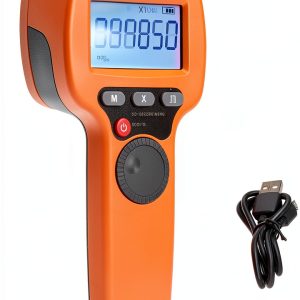
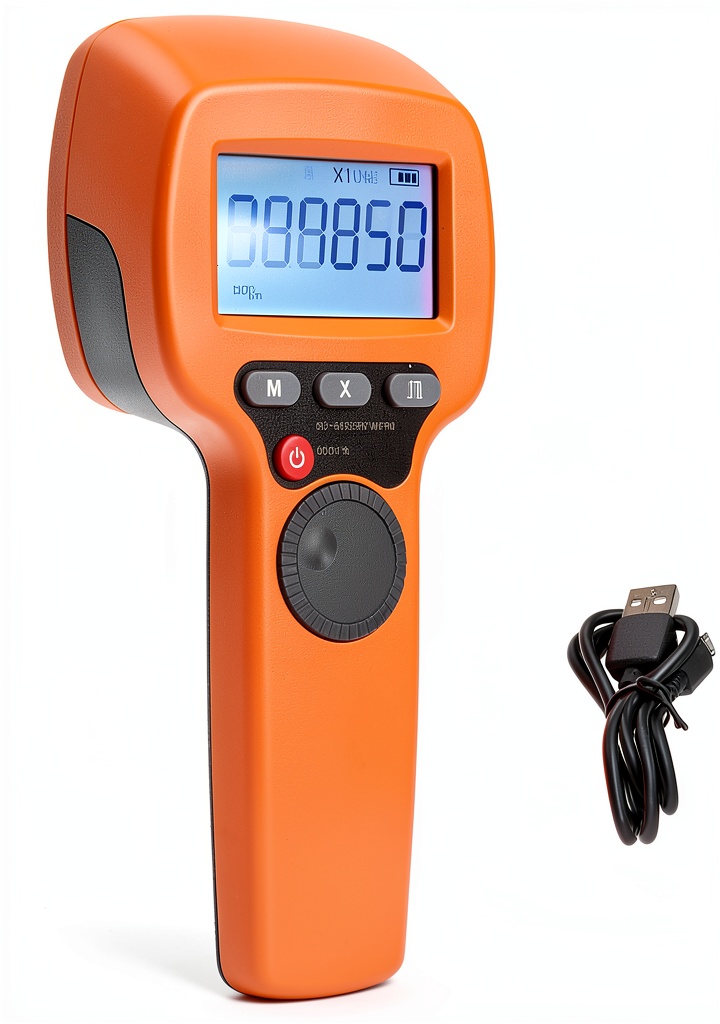
Unboxing the Hyuduo reveals a tool that feels substantial without being cumbersome. The 1.03-pound weight strikes a balance between stability during use and fatigue-free operation during extended inspections. Compared to cheaper plastic alternatives, the housing has a reinforced texture that withstands minor drops and resists oil absorption – a critical detail in industrial environments.
The button layout prioritizes essential functions: power, frequency adjustment, and measurement modes. During testing, I appreciated the tactile feedback that worked reliably even with gloved hands. The display provides clear digital readouts with good contrast under various lighting conditions, though direct sunlight can make it difficult to read.
Performance in Real Use
Where the Hyuduo truly proves its value is in practical measurement scenarios. Testing on a 15HP industrial fan motor revealed both the tool’s capabilities and limitations.
Scenario 1: Baseline RPM Measurement – The motor nameplate indicated 1780 RPM at 60Hz. Using the stroboscope with a simple chalk mark on the fan blade, I obtained a reading of 1775 RPM after several adjustments. The process took approximately 2 minutes once the marker was applied. The advantage here was verifying actual operating speed without any physical contact or shutdown required.
Scenario 2: Printing Press Inspection – On a flexographic printing press running at 220 FPM, the Hyuduo helped identify a slight speed variation between print stations. By marking different rollers and comparing readings, we detected a 3% differential that explained inconsistent registration. This would have been impossible with contact tachometers due to accessibility constraints.
The stroboscopic method requires understanding that you’re matching flash frequency to rotation speed. When properly synchronized, the marked object appears stationary, allowing precise measurement. Beginners often struggle with this concept initially but typically achieve proficiency within 30-60 minutes of practice.
Ease of Use
For technicians familiar with stroboscopes, the Hyuduo presents minimal learning curve. The interface follows conventional design patterns with frequency adjustment knobs and mode selection buttons where expected.
However, for those transitioning from contact tachometers or laser phototachometers, there’s a conceptual hurdle. The fundamental principle – that you’re not directly measuring rotation but rather finding the frequency that makes motion appear frozen – requires mental adjustment. During training sessions I’ve conducted, this typically takes 3-5 practice measurements before technicians feel confident.
The documentation provides adequate basic instructions, but lacks advanced troubleshooting guidance for difficult measurement scenarios like highly reflective surfaces or variable-speed equipment.
Durability & Reliability
After three months of regular use in manufacturing environments, the Hyuduo has maintained consistent performance without calibration drift. The housing shows minimal wear despite occasional contact with metal surfaces and lubricants.
The claimed 8-hour battery life proved accurate during continuous use for plant-wide equipment surveys. More importantly, the standby time means the tool remains charged and ready even after weeks of storage – a practical advantage over tools with parasitic battery drain.
The LED strobe shows no degradation in brightness or color temperature, which is crucial for maintaining measurement accuracy over time. Cheaper stroboscopes often suffer from LED output variation that affects reading consistency.
Pros & Cons
Advantages:
- True non-contact measurement – eliminates safety risks and equipment damage potential
- Exceptional battery performance – outlasts most competitors during extended shifts
- Clear visual feedback – allows inspection of components while measuring speed
- Reasonable learning curve – most users achieve proficiency within an hour
- Cost-effective solution – provides digital accuracy without premium pricing
Limitations:
- Requires visual markers – difficult on dirty or inaccessible surfaces
- Limited to fundamental frequency – cannot detect harmonic vibration patterns
- Ambient light sensitivity – bright environments can reduce strobe effectiveness
- No data logging – manual recording required for historical analysis
- Basic display – lacks graphical representation of measurements
Comparison & Alternatives
Understanding where the Hyuduo fits in the measurement tool ecosystem helps determine if it’s the right choice for your specific needs.
Cheaper Alternative: Mechanical Tachometer
Basic mechanical tachometers using physical contact with rotating shafts cost $30-50 but introduce significant limitations. They require direct access to rotating components, pose potential safety hazards, and typically offer accuracy of ±5% compared to the Hyuduo’s ±1% capability. Choose mechanical only for occasional use on easily accessible equipment where approximate readings suffice.
Premium Alternative: SKF TKRT 31 Advanced Digital Tachometer
Professional-grade instruments like the SKF TKRT 31 ($400+) offer enhanced capabilities including data logging, programmable alarms, and connectivity to maintenance software systems. These tools provide measurement traceability and integration with condition monitoring programs. Choose premium alternatives when you require documentation for compliance, trend analysis, or integration with predictive maintenance systems.
The Hyuduo occupies the sweet spot between these extremes – offering digital accuracy and non-contact safety without the cost of enterprise-grade features that many maintenance departments don’t require.
Buying Guide / Who Should Buy
Best for beginners: The Hyuduo represents a reasonable starting point for technicians new to rotational measurement. The digital readout eliminates interpretation errors common with analog dials, while the straightforward controls prevent overwhelm. Practice on known-speed equipment first to build confidence with the stroboscopic principle.
Best for professionals: Experienced maintenance teams will appreciate the Hyuduo as a reliable daily-use tool for quick equipment verification. Its durability and battery life support continuous use during plant surveys, while the non-contact method enables measurements in confined or hazardous spaces where contact tools can’t reach.
Not recommended for: Researchers, precision mechanics, or anyone requiring vibration spectrum analysis should look beyond the Hyuduo. The tool measures fundamental frequency only, missing harmonic content that reveals bearing wear, imbalance, and other mechanical faults. Similarly, applications requiring measurement documentation or historical trending need tools with data logging capabilities.
FAQ
How accurate is the Hyuduo compared to laser tachometers?
In controlled conditions, both can achieve ±1% accuracy. However, laser tachometers require reflective tape application and precise alignment, while the stroboscope works with any visible marker. The Hyuduo maintains accuracy better in vibratory environments where laser alignment becomes challenging.
Can I measure variable speed equipment?
Yes, but with limitations. The Hyuduo provides instantaneous readings, so you can track speed changes manually. For capturing rapid variations or transient events, you’d need a tool with recording capability, which the Hyuduo lacks.
What’s the actual learning curve for beginners?
Most users achieve basic proficiency within 30 minutes by practicing on a known-speed source like a variable frequency drive-controlled motor. Advanced techniques like harmonic analysis and slip measurement typically require 2-3 hours of guided practice.
Is the battery replaceable or user-serviceable?
The internal lithium battery isn’t designed for user replacement, which could concern some industrial users. However, the claimed 500+ charge cycles should provide 3-5 years of typical use before significant capacity degradation.
When should I choose a contact tachometer instead?
Contact models remain preferable when visual markers can’t be applied, such as on highly reflective, dirty, or extremely hot surfaces. They also work better in brightly lit environments where strobe effectiveness diminishes.